
Reminderly.ai vs Tasks.Bot for Email Automation Software
Your team already lives in WhatsApp, so why add another app for reminders? Email automation tools promise scheduled nudges and task follow-ups, but they rarely reach field staff who never open a desktop inbox. Choosing the wrong platform means missed deadlines and duplicate work.
This comparison shows what Tasks.Bot does inside WhatsApp, where email automation fits, and how it differs from Reminderly.ai. You will learn who each tool serves, what features matter for field teams, and how pricing and beta status affect your decision.
What Is Tasks.Bot?
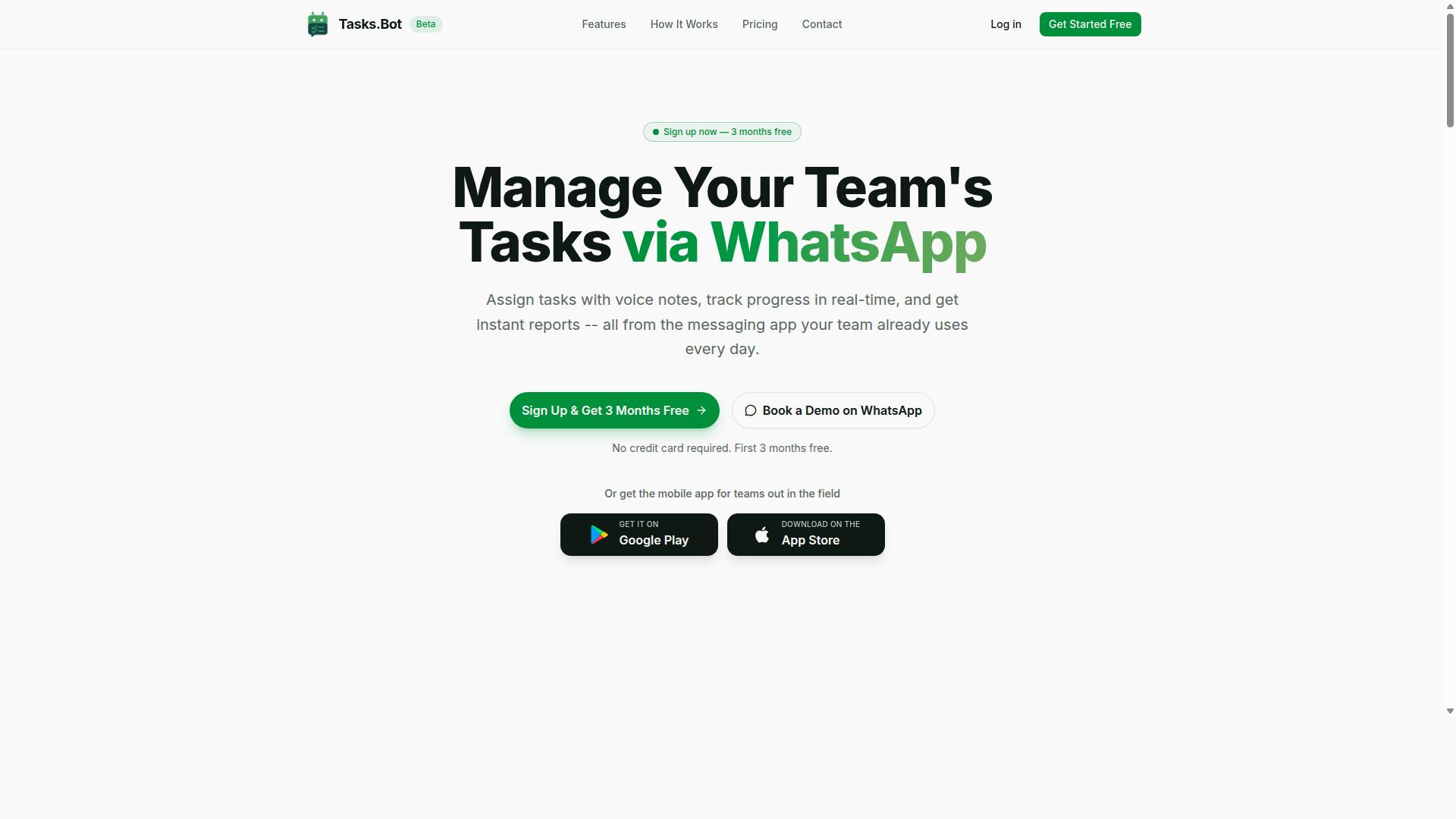
Tasks.Bot is a task management platform that operates entirely within WhatsApp, enabling teams to assign tasks, track progress, and receive reports without leaving the messaging app. For teams already saturated with logins and dashboards, that single design choice changes how work actually gets done.
Instead of asking every team member to install new software or create yet another account, Tasks.Bot runs where the conversation already happens. Everything takes place inside WhatsApp, so onboarding is less about training people on a new tool and more about sending them a message.
Tasks.Bot also offers a mobile app for field teams, which matters for staff who are rarely at a desk. The service is currently in beta and includes a free trial period, so teams can evaluate whether a WhatsApp-first approach fits their workflow before committing.
The core purpose is straightforward: simplify task assignment, progress tracking, and reporting for teams that already use WhatsApp. Rather than forcing a migration to a separate project management suite, Tasks.Bot meets teams in the channel they open dozens of times a day. That lowers the barrier for adoption, especially among workers who are comfortable with messaging apps but less so with traditional software.
It is worth noting what Tasks.Bot is not. It is not an email automation tool in the traditional sense, and it does not position itself as an AI email assistant or inbox management platform. Its focus is task management, attendance tracking, and reporting delivered through WhatsApp. For readers comparing it against email automation software, that distinction matters: Tasks.Bot solves coordination and follow-through, not inbox triage or email scheduling.
Who Tasks.Bot Serves: WhatsApp-First Teams and Field Staff
Tasks.Bot is designed for teams that rely on WhatsApp for communication, especially those with field staff who need to manage tasks, track attendance, and log payroll-ready hours. These are teams where the group chat is already the operational hub.
The audience breaks down into a few recognizable groups:
- Field staff who work away from a desk and need to receive assignments, confirm completion, and log hours without opening a laptop
- Remote workers who coordinate primarily through messaging and want tasks to live alongside their conversations
- Small to medium businesses that need task management, attendance tracking, and payroll-ready hours without adding another subscription or training cycle
What unites these teams is a practical constraint: they do not want to switch apps to get work organized. A field technician finishing a job does not want to open a project management tool, navigate to a task, and update a status. If the update can happen in the same thread where the job was assigned, it is far more likely to happen at all.
Tasks.Bot addresses that gap by keeping assignment, progress tracking, and reporting in one place. The payroll-ready hours element is particularly relevant for businesses that currently reconstruct timesheets from chat messages at the end of the week, a process that is slow and error-prone.
According to the brand, hundreds of teams already use the service. That adoption signals the model resonates with organizations that treat WhatsApp as infrastructure rather than a casual chat tool. For teams weighing email automation software against a WhatsApp-native task platform, the deciding question is simple: where does your team actually communicate? If the answer is WhatsApp, Tasks.Bot is built for you.
Does Tasks.Bot Offer Email Automation Software?
Tasks.Bot does not offer traditional email automation software; instead, it focuses on task and reminder management within WhatsApp, though it can complement email-based workflows. If you are searching for email automation software in the style of Reminderly.ai, Tasks.Bot is a different category of tool. It does not send, parse, or schedule emails, and it does not act as an inbox assistant.
What it does instead is automate work inside WhatsApp, which is where many teams already communicate. The platform uses AI to understand user intent and create tasks from messages, so assignments and updates happen in the same thread where conversations already take place. That makes it a task automation tool rather than an email productivity tool.
So the direct answer to the question is no. Tasks.Bot is not an email automation platform, and it should not be evaluated against Reminderly.ai on inbox features such as email parsing, email triage, or follow-up automation. Its strengths sit in a different channel entirely.
Where Tasks.Bot does deliver automation is in the flow of everyday work. Its core capabilities include:
- Voice note task creation, so a spoken message becomes a task
- Automatic task assignment to the right person
- Smart deadline reminders that keep work on schedule
- Approvals and automations for routine decisions
- Instant reports for visibility into progress
- Tasks on a map, a live day tracker, and face-verified attendance
- Shifts, leave, and hours management
These features cover reminder automation and task management rather than email scheduling. If your team's bottleneck is chasing status updates, this is the kind of capability that removes that manual effort.
None of this means email has no place. Many organizations run a WhatsApp-based task layer alongside a separate email tool, using each for what it does best. Tasks.Bot can be used alongside email tools for task management, keeping assignments and deadlines in one place while email handles correspondence.
It also offers Android and iOS apps with push notifications, voice capture, and a home screen widget, plus native WhatsApp integration. That means the automation follows you onto mobile, which matters for field teams and staff who are rarely at a desk.
If your priority is an AI email assistant for inbox management, Tasks.Bot is not that product. If your priority is getting tasks created, assigned, tracked, and completed without leaving WhatsApp, it is built for exactly that job.
Reminderly.ai vs Tasks.Bot: How the Two Tools Differ
Reminderly.ai and Tasks.Bot serve different primary channels: Reminderly.ai specializes in email automation, while Tasks.Bot focuses on task and reminder management within WhatsApp.
Both products aim to cut down on the manual work that slows a team down. The difference is where that work happens. Reminderly.ai lives in the inbox. Tasks.Bot lives in the chat app your team already opens dozens of times a day.
Reminderly.ai is an AI email assistant built for inbox management, email scheduling, and follow-up automation. It suits knowledge workers who spend their day in Gmail or Outlook and want help triaging messages and chasing replies.
Tasks.Bot is a WhatsApp-based task manager. It uses AI to understand user intent and create tasks from messages, covering task automation, automated reminders, and reporting for teams that coordinate through chat rather than email.
That split shapes everything else. A sales team sending proposals may want an email productivity tool. A field crew, delivery team, or service staff may never touch email for their daily work at all.
The sections below break down how Tasks.Bot operates inside WhatsApp and where email automation fits, plus where it does not.
Task and Reminder Management Inside WhatsApp
Tasks.Bot leverages WhatsApp's ubiquity to let teams create tasks via voice notes or text, assign them automatically, and receive smart deadline reminders, all without leaving the chat.
The core idea is that no one needs to install another app or learn a new interface. Tasks.Bot provides native WhatsApp integration, so the conversation itself becomes the workspace.
Creating a task takes one message. A field worker can send a voice note saying "Fix AC at client site by Friday." The AI interprets the natural language, creates the task, and assigns it. No form, no dropdown menu, no separate to-do list.
From there, the platform handles the follow-through:
- Voice note task creation for hands-free input
- Automatic task assignment based on the message
- Smart deadline reminders so work does not slip
- Approvals and automations for sign-off steps
- Instant reports on task status and completion
Beyond tasks, Tasks.Bot covers face-verified attendance, shifts, leave, and hours management. It also includes tasks on a map and a live day tracker, which help managers see where work stands in real time.
For teams that want app access too, Tasks.Bot offers Android and iOS apps with push notifications, voice capture, and a home screen widget. The WhatsApp channel remains the default, and the apps extend it rather than replace it.
Contrast that with Reminderly.ai, which operates through email. Both approaches reduce manual coordination, but only one meets a WhatsApp-first team where it already works.
Where Email Automation Fits - and Where It Doesn't
Email automation tools like Reminderly.ai excel at managing inboxes, scheduling emails, and automating follow-ups, but they don't handle field task management or WhatsApp-based workflows.
That is not a flaw. It is a scope decision. An AI email assistant earns its keep by parsing incoming mail, supporting email triage, and keeping a priority inbox under control. It can also handle email scheduling and follow-up automation, which matters when deals and approvals move through threads.
Where email automation runs into limits is anywhere the work does not happen in an inbox:
- Field staff who never sit at a desk
- Shift-based teams tracking attendance and hours
- Task tracking that needs approvals inside a chat thread
- Reporting that has to reflect same-day field activity
Tasks.Bot is built for exactly those cases. Its strengths are task tracking, attendance, and reporting for teams that communicate through WhatsApp, with features like face-verified attendance, shifts and leave management, and instant reports.
The two tools can also work side by side. A company might use Reminderly.ai for client email and Tasks.Bot for WhatsApp-based task management, keeping each channel's workflow in the tool designed for it.
The practical question is simple. If your team's work lives in email, an email productivity tool fits. If it lives in WhatsApp, Tasks.Bot fits. For mixed teams, running both covers the gap that neither closes alone.
Key Features and What Makes Tasks.Bot Stand Out
Tasks.Bot differentiates itself with AI-powered natural language processing, voice note task creation, and a suite of features tailored for WhatsApp-first teams. Instead of asking users to adopt yet another dashboard or app, it operates entirely within WhatsApp, so team members don't need to install anything or create new accounts.
That single design decision shapes everything else. Tasks arrive where conversations already happen, which means less friction and faster adoption across a team. The platform also uses AI to understand user intent and create tasks from messages, cutting out the copy-paste routine that slows down manual task entry.
Beyond task creation, Tasks.Bot covers the operational side of team work. It includes approvals and automations, instant reports, tasks on a map, a live day tracker, face-verified attendance, and shifts, leave, and hours management. Native WhatsApp integration ties these pieces together rather than scattering them across separate tools.
Security and access matter too. Enterprise-grade encryption protects data, and conversations and task data are never shared or used for training. Android and iOS apps add push notifications, voice capture, and a home screen widget for users who want a native mobile layer alongside WhatsApp. A 3-month free trial with no credit card required lets teams evaluate the fit before committing.
Voice Notes, AI Task Creation, and Smart Deadline Reminders
Tasks.Bot's AI engine interprets voice notes and text messages to create tasks, assign them to the right people, and set smart deadline reminders automatically. A manager can send a voice note like "Remind John to submit the report by Thursday" and the system parses the intent, builds the task, assigns it to John, and schedules the reminder.
The same applies to typed messages. A short instruction such as "Ask Priya to follow up with the vendor tomorrow" becomes a tracked task with an owner and a due date, no form filling required. This is where natural language processing earns its place in a task automation workflow: the message is the input, and the task is the output.
The practical benefit is speed. Manual entry, switching between apps, and retyping instructions into a task manager all disappear when delegation happens inside the chat thread. Teams that already run on WhatsApp avoid the context switch entirely, and the person assigning work does not need to open a separate tool to do it.
Smart deadline reminders close the loop. Once a task exists with a due date, reminders keep it visible without anyone chasing status manually. For recurring work, recurring reminders handle the repetition. The result is fewer missed deadlines and less time spent asking whether something was done.
It is worth being precise about scope here. Tasks.Bot is a task management and reminder automation tool built around messaging, not a full email client. Teams comparing it against an AI email assistant or email productivity tool should treat it as a complementary layer: work that starts in a chat gets captured, assigned, and tracked, rather than living only in an inbox.
Face-Verified Attendance, GPS Tracking, and Instant Reports
For field teams, Tasks.Bot offers face-verified attendance, GPS tracking, and instant reports, ensuring accountability and real-time visibility. Face verification confirms that the person checking in is the person scheduled, which addresses the buddy punching problem that undermines attendance records in distributed teams.
Live GPS tracking adds location context to that record. A manager can see who checked in and where, which matters for staff working across sites, routes, or client locations rather than a single office. Combined with the live day tracker, this gives a running picture of the working day instead of a record reconstructed after the fact.
Instant reports pull the threads together. They summarize task progress, attendance, and hours in a form a manager can review without assembling spreadsheets by hand. A daily report might show who checked in, where they were, which tasks moved forward, and how hours were logged.
These features are most valuable for remote and field-based operations, where visibility is normally the hardest thing to maintain. Shifts, leave, and hours management sit alongside attendance so scheduling and payroll inputs come from the same source as the work itself. Tasks on a map extend the same idea to the work items, not just the people.
For teams weighing this against Reminderly.ai for email automation software, the distinction is clear. Reminderly.ai centers on email scheduling and follow-up automation. Tasks.Bot centers on WhatsApp-based task management with attendance and location accountability built in. Teams whose work happens in chat and in the field will find the Tasks.Bot feature set more directly aligned with how they actually operate.
Pricing and Plans
Tasks.Bot offers a single 'Full Access' plan with all features included, priced at ₹200 per member per month or ₹1,200 per member per year. There are no starter, pro, or enterprise tiers to compare. Every user gets the same complete set of capabilities from day one.
That flat structure matters when you are evaluating email automation software. Many tools push you into a higher tier just to unlock follow-up automation or task management. With Tasks.Bot, the decision comes down to one question: monthly or annual billing.
The annual plan works out to ₹1,200 per member per year, which equals roughly ₹100 per month. Compared with paying month to month, that is a 50% saving, or ₹1,200 saved per member each year. For a small team, those savings add up quickly.
Pricing is listed in both Indian Rupees and US Dollars. The site shows a 'Select currency' option, so you can switch between the two before you commit. If you bill in dollars, verify the current rate at checkout rather than assuming a fixed conversion.
New users also get 3 months free, with no credit card required, and can cancel anytime. That makes it easy to test reminder automation and task management before spending anything.
One thing to note: the service is currently in beta. Pricing and plan details may change as the product develops, so confirm the current terms on the site before purchasing.
For a solo user, the monthly plan keeps costs flexible. For a team of five on the annual plan, the total comes to ₹6,000 per year, the same as paying for only three members monthly. That is the core value argument: one price, every feature, and a clear discount for committing annually.
Trust Signals: Beta Status, Free Trial, and Refund Policy
Tasks.Bot is currently in beta, offers a 'Book a Demo on WhatsApp' option, and mentions a refund policy, providing transparency and low-risk adoption. For anyone comparing email automation software, these signals matter more than a polished landing page. They show what a product is willing to put in writing before you commit time or money.
Beta status is often misunderstood. It does not mean the tool is unfinished or unreliable. It means the team is still refining features based on real usage, while the core product is already in the hands of hundreds of teams. For buyers, that translates into a practical trade-off: you get access to a tool that is actively improving, and you accept that some corners of the interface may still shift.
That trade-off is worth understanding before you sign up for any email automation platform. A product in beta usually ships updates faster than a mature one, because feedback loops are shorter and the roadmap is still flexible. If your workflow depends on reminder automation or follow-up automation, a responsive development cycle can work in your favour. The key is knowing what stage the product is at, and Tasks.Bot states that openly rather than hiding it.
The 'Book a Demo on WhatsApp' option is the most direct trust signal here. Instead of asking you to commit blind, it lets you see the product in action and ask questions before deciding. That is a meaningful step for a category like email productivity tools, where fit depends on how you handle inbox management, email scheduling, and task management day to day.
A demo also helps you judge whether a tool suits your setup. If you rely on Gmail integration, Outlook integration, Google Workspace, or Microsoft 365, you can ask how those connections work in practice. If you use Zapier, IFTTT, or Make, or need an API integration or webhook, a live conversation clarifies what is supported today versus what is planned. That is far more useful than guessing from a feature page.
It also gives you a chance to probe the parts of email automation software that are hardest to evaluate from marketing copy. Ask how natural language processing and machine learning shape the AI assistant behaviour. Ask what email parsing, email triage, and a priority inbox look like in your workflow. Ask how smart notifications, recurring reminders, and deadline tracking behave when your to-do list integration is connected. A demo turns vague promises into concrete answers.
The refund policy mentioned in the footer is the third pillar of trust. A published refund policy shifts risk away from the buyer. It signals that the company expects to earn your continued use, not just your first payment. For a tool still in beta, that combination of openness about stage, a hands-on demo path, and a stated refund option is a reasonable basis for trying it.
When you evaluate any virtual assistant or chatbot for email, weigh these signals together rather than in isolation:
- Stage transparency: the product tells you it is in beta instead of implying full maturity.
- Pre-commitment access: a demo on WhatsApp lets you assess fit before adopting.
- Refund policy: a stated policy reduces the cost of a wrong decision.
- Real usage: hundreds of teams already rely on it, which suggests the core workflow holds up.
None of these replace your own judgement, but together they answer the question buyers actually care about: what happens if this is not right for me? Tasks.Bot addresses that directly, which is a stronger position than silence.
Who Should Use Tasks.Bot
Tasks.Bot is ideal for teams that communicate via WhatsApp, particularly those with field staff who need task assignment, attendance tracking, and payroll-ready hours. The platform is built around the way these teams already work, so there is no need to change daily habits or train staff on unfamiliar software.
Because WhatsApp is the primary channel for so many field and remote teams, Tasks.Bot fits naturally into existing routines. Workers receive assignments, confirm completion, and log their time without leaving the app they already use every day. That simplicity is a major reason hundreds of teams already rely on the service.
By contrast, if email is the main way your team coordinates, a dedicated email automation software like Reminderly.ai may suit you better. Tools in that category focus on inbox management, email scheduling, and follow-up automation. Tasks.Bot takes a different path. It is purpose-built for WhatsApp-centric coordination, where quick messages and group chats drive the workday.
Small and medium businesses tend to get the most value because they often lack the budget or staff for complex project management suites. A single WhatsApp-based system for task management, attendance, and hours keeps operations lean. There is no need to stitch together separate apps for to-do list integration or time tracking.
Field service teams are another strong fit. Crews spread across multiple sites need clear instructions and a simple way to report back. Tasks.Bot handles both without requiring a laptop or a desk. Remote teams with flexible schedules benefit too, since assignments and updates stay visible in a shared channel everyone already checks.
Industries that commonly match this profile include:
- Construction, where crews move between sites and need daily task assignment
- Maintenance and repair services, where jobs are dispatched and confirmed on the go
- Sales teams working in the field who need follow-ups and activity tracking
- Cleaning, security, and facilities teams with shift-based attendance needs
- Any small business already running operations through WhatsApp groups
For these groups, the appeal is straightforward. Attendance tracking and payroll-ready hours come from the same place tasks are assigned, which cuts down on paperwork and manual reconciliation. Managers get a clearer view of who did what and when, without chasing spreadsheets.
If your team lives in email all day, Tasks.Bot is probably not the right centerpiece for your workflow. But if WhatsApp is where coordination already happens, and you need task automation plus reliable time records, Tasks.Bot is the natural choice. It meets teams where they are rather than forcing a new tool into the mix.
Final Verdict: Which Tool Fits Your Workflow?
Choose Tasks.Bot if your team lives in WhatsApp and needs task management, attendance tracking, and reporting; choose Reminderly.ai if your workflow revolves around email automation and inbox management. That single distinction settles most decisions. The two products are built around different communication channels, and the channel your team already uses every day should drive the choice.
Tasks.Bot is designed for teams that coordinate through WhatsApp rather than a shared inbox. Its value shows up in task management, attendance tracking, and reporting, all handled through the channel your people already have open. If your daily coordination happens in chat, adding an email-first tool creates a second place to check. Tasks.Bot keeps the work where the conversation already is.
Reminderly.ai makes more sense when email is the center of gravity. Teams that run on email automation, inbox management, and follow-up sequences will find that an email-centric tool matches how they already work. If your clients, leads, and internal updates all arrive as messages in a mailbox, an email productivity tool fits the flow without forcing a channel change.
Here is a simple way to decide:
- WhatsApp-first teams: pick Tasks.Bot for task management, attendance tracking, and reporting in the channel your team already uses.
- Email-centric teams: pick Reminderly.ai when inbox management and email automation drive most of your daily work.
- Mixed teams: use both, with Tasks.Bot handling chat-based coordination and Reminderly.ai covering the mailbox.
Using both together is a practical option rather than a compromise. A team can run task automation and attendance tracking through Tasks.Bot while Reminderly.ai handles email follow-ups and inbox triage. The two cover different channels, so they rarely overlap in a way that creates confusion. For organizations that operate across chat and email, that split gives fuller coverage than either tool alone.
If your team is WhatsApp-first, the verdict is clear: Tasks.Bot is the fit. It keeps task management, attendance tracking, and reporting in one place, in the channel your people already use. To get started or book a demo on WhatsApp, contact Tasks.Bot by phone at +91 97143 42522 or email [email protected].
Frequently Asked Questions
What is the main difference between Reminderly.ai and Tasks.Bot?
Tasks.Bot is a task management platform that operates entirely inside WhatsApp, so your team can assign tasks, track progress, and receive reports without installing anything or creating new accounts. Reminderly.ai is a separate email automation tool, so the two are built for different workflows. If your team already runs on WhatsApp, Tasks.Bot keeps everything in the app you're already using.
Do my team members need to download a new app to use Tasks.Bot?
No. Tasks.Bot works via WhatsApp, so team members don't need to install anything or create new accounts - they simply use the WhatsApp they already have. There's also a mobile app available for field teams who need it. This makes onboarding much faster than rolling out a brand-new tool.
Can Tasks.Bot handle task creation from voice notes and natural language?
Yes. Tasks.Bot uses AI to understand natural language and voice notes, so you can create tasks just by speaking or typing a message the way you normally would. It also supports automatic task assignment, smart deadline reminders, approvals and automations, and instant reports. This means less time spent formatting tasks and more time getting work done.
Does Tasks.Bot support field teams and attendance tracking?
Yes. Tasks.Bot is designed with field staff in mind, offering face-verified attendance, tasks on a map, live day tracking, and payroll-ready hours. It's built for teams that use WhatsApp for communication and need task management, attendance, and reporting in one place. A mobile app is also available for field teams.
How much does Tasks.Bot cost compared to Reminderly.ai?
Tasks.Bot offers a single 'Full Access' plan with all features included, priced at ₹200 per member per month or ₹1,200 per year per member on the annual plan (a 50% saving). Pricing is available in both Indian Rupees and US Dollars. For Reminderly.ai's current pricing, check their website directly, as we can only speak to our own plans.
Is Tasks.Bot available globally, and how do I get started?
Yes - Tasks.Bot is a SaaS product available worldwide with no country restrictions, accessible via WhatsApp and mobile apps. You can book a demo on WhatsApp directly from the website, or reach the team at [email protected] or +91 97143 42522. The service is currently in beta, and a refund policy is listed in the site footer.
Recommended Resources: